3 What is Precorrection?
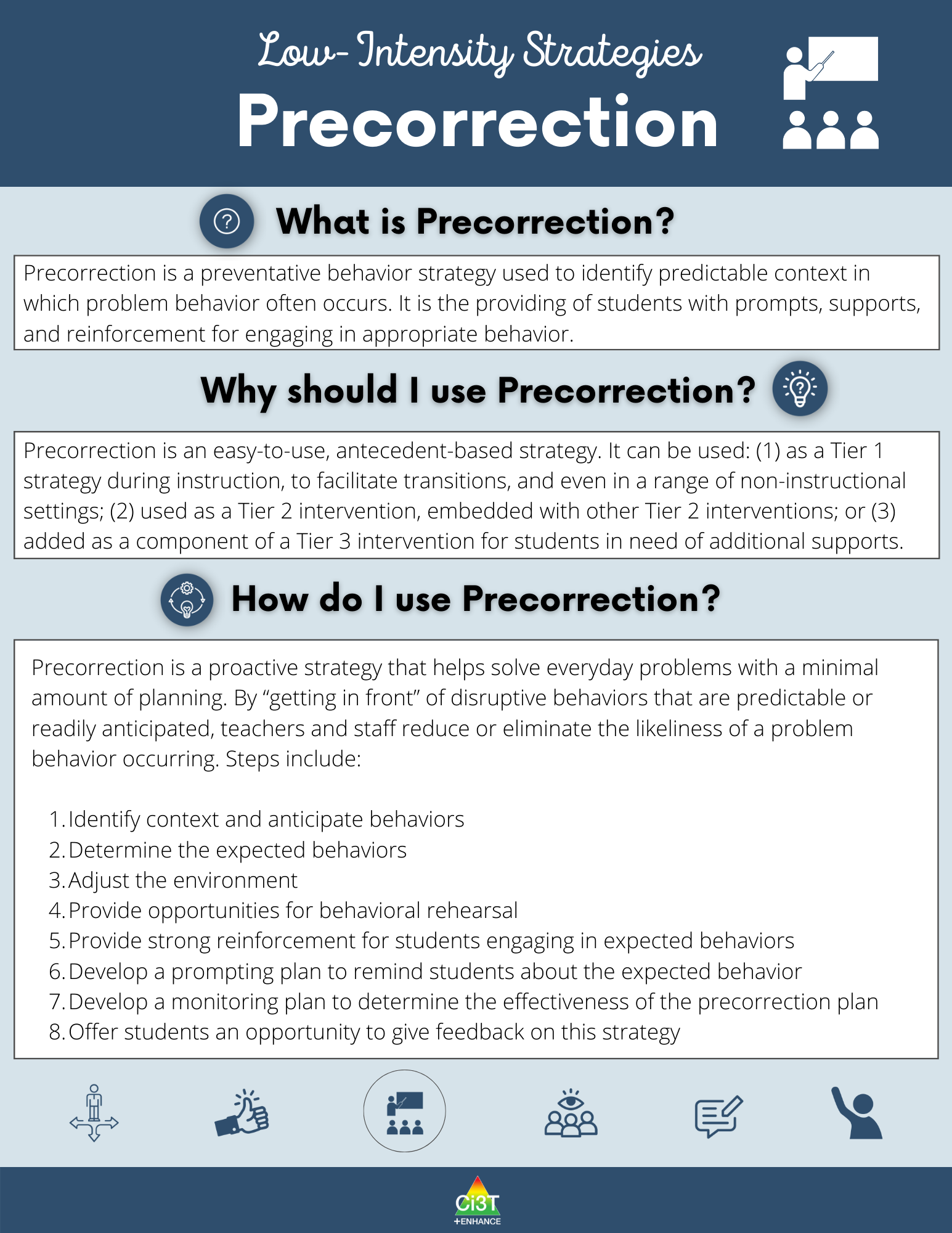
Precorrection is a proactive strategy that helps solve everyday problems with a minimal amount of planning. By “getting in front” of disruptive behaviors that are predictable or readily anticipated, teachers and staff reduce or eliminate the likeliness of a problem behavior occurring. A little preplanning with the preventative strategy of precorrection means problem behaviors are dealt with before they occur, instead of reacting to them after they occur (Haydon et al., 2012). Precorrection is an antecedent-based positive behavior support (learn more below) that emphasizes changing the environment to promote student engagement and reduce the likelihood of challenging behavior.
What are antecedent-based strategies?
An antecedent is an event that occurs before a behavior. So, an antecedent-based strategy is an approach that focuses on altering the environment before a behavior occurs. The aim is to prevent an undesired behavior, such as disruption or work refusal, or to increase the odds that desired behaviors will occur, such as making it more likely for a student to follow directions or complete their work. Antecedent-based strategies are often appreciated by teachers, as they are proactive, meaning they are used before challenging behaviors (e.g., disruption) occur, setting the stage for preferred behaviors (e.g., engagement). 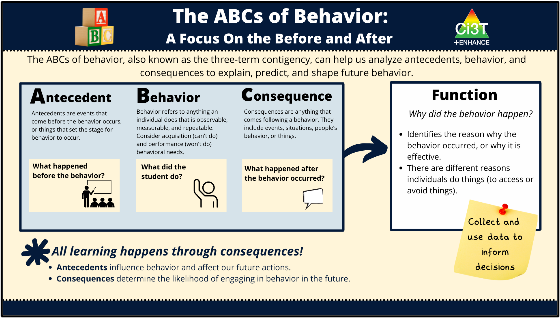 Check out the ABCs of Behavior infographic to learn more about how the three-term contingency (Antecedent-Behavior-Consequence) helps us understand why certain behaviors happen more often than others!
Precorrection includes visual supports (e.g., setting expectation posters) and verbal prompts delivered shortly before a problem behavior is anticipated in the authentic setting where it usually occurs (e.g., classroom or gym; Haydon & Scott, 2008), followed by strong reinforcement for engaging in appropriate behavior. This strategy has great flexibility. It is usable in virtually any setting – including remote instruction! – with any group of students and is easily adapted to any activity or subject area where problem behaviors are anticipated. In fact, many teachers already use precorrection as part of their regular practices. For example:
- A teacher might remind the whole class that an activity’s time is almost up, and they will be cleaning up and transitioning to the next subject in a few minutes. The teacher might then ask who can name one way they will show responsibility during the transition (e.g., clean and return all materials, walk safely, keep hands and feet to self). By this reminder, the teacher has given advance warning of a routine where they anticipated disruptive behavior (e.g., complaining about stopping the activity, leaving a mess at the activity area, physical conflict between students, running in class), and prompted students to think about which school-wide expectations would apply.
- A teacher who reminds students to use a recently taught and reviewed mnemonic strategy to check math work (e.g., long division steps, order of operations calculations, solving algebraic equations), helping students focus on the process and turn to the strategy before asking a peer or the teacher for help.
- A teacher asks, “It’s time to line up for lunch. Who can raise their hand and tell the class one way we show respect in the hallway and in the cafeteria?” “That’s correct, Angelique, push in your chair and form a silent line at the door.” This teacher precorrected for (a) students shouting out by reminding them to raise their hand if they have an answer, (b) unsafe chair legs by reminding students to push in their chairs, (c) disruption at the door by reminding students to form a quiet line, (d) disruption in the hallway by having the student repeat a hallway expectation, and (e) disruption in the cafeteria by having the student remind the class of a cafeteria expectation.
Although the content of these examples differs, what all three teachers have in common is the fact that they provided their students with a proactive reminder of what behaviors were expected with the goal of heading off problems before they arise. There are different ways in which precorrection can be utilized by classroom teachers. As one example, precorrection can be used to remind students of expected behaviors before transitioning to another activity or location. For example, a teacher might say “Class, we are about to enter the library so let’s remember that we need to keep our voices at Level 1 and find a seat at a table once you have put the book you are returning in the slot.” As another example, precorrection can be used to review procedures and expectations for students using class materials and manipulatives (e.g., individual white boards, math manipulatives, science experiment materials, art supplies) before handing them out to students or beginning the activity. For example, a teacher might say “Class, I am going to pass out the whiteboard and marker that you are going to need for our next lesson. Remember that you should leave the cap on your marker and your whiteboard on your desk until I tell you we are ready to use them.” Below are several more examples of how precorrection may be used across the school day.
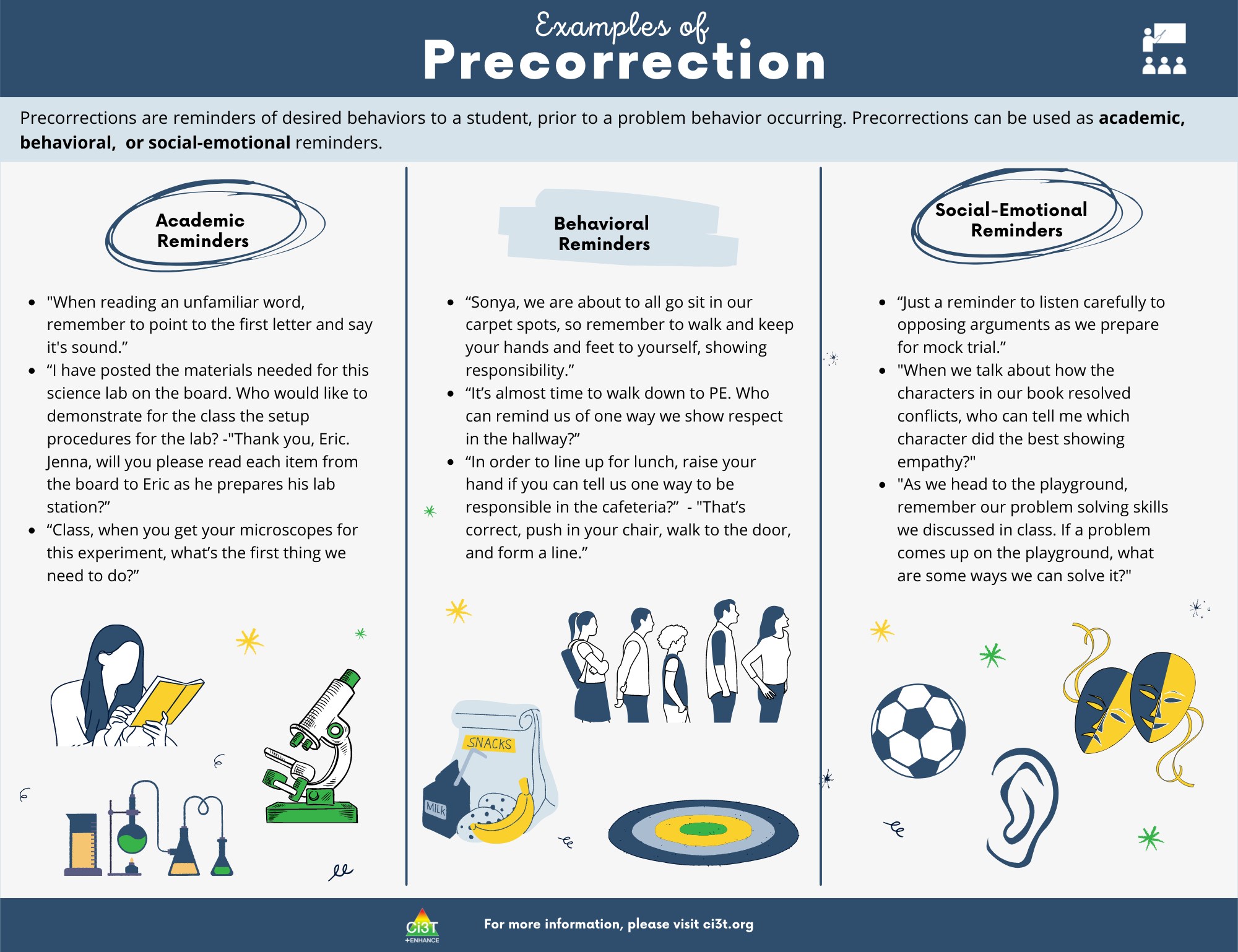
Precorrection Examples
- “It’s almost time to walk down to PE – who can remind us of one way we show respect in the hallway?”
- “In order to line up for lunch, raise your hand if you can tell us one way to be responsible in the cafeteria?” “That’s correct, push in your chair, walk to the door, and form a line.”
- “When reading an unfamiliar word, remember to point to the first letter and say its sound.”
- “Class, in five minutes we’re going to start cleaning up and transition to math work.”
- “Class, when you hear the bell remember to be respectful and wait until I dismiss you. I’ll know you’re ready because you’ve picked up one piece of trash and are sitting calm and in control at your desk.”
- “Class, when you get your microscopes for this experiment, what’s the first thing we need to do?”
- “When you return to the classroom a quiet line outside the door will show you are ready and responsible. When you enter, remember to respect each other’s personal space, go straight to your desk, and begin the warm-up activity on the board, showing best effort.”
- “I have posted the materials needed for this science lab on the board. Who would like to demonstrate for the class the setup procedures for the lab? Thank you, Eric. Jenna, will you please read each item from the board to Eric as he prepares his lab station?”
- “Just a reminder to listen carefully to opposing arguments as we prepare for mock trial.”
As you can imagine from these examples, there are many possibilities for implementing precorrection in your classroom. This low-intensity strategy is versatile, both in the manner in which it can be implemented, and the way it can be used in an integrated tiered system. For example, precorrection can be:
- used classwide as a Tier 1 strategy to promote academic engagement and reduce disruptive behavior
- used as a stand-alone Tier 2 intervention in more targeted fashion to assist students with moderate levels of risk who need more than Tier 1 has to offer
- embedded with other Tier 2 interventions such as using precorrection within the context of a social skills group
- added as an antecedent component of an intensive intervention such as functional assessment-based intervention (FABI) for students in need of Tier 3 supports
FABI Tip!
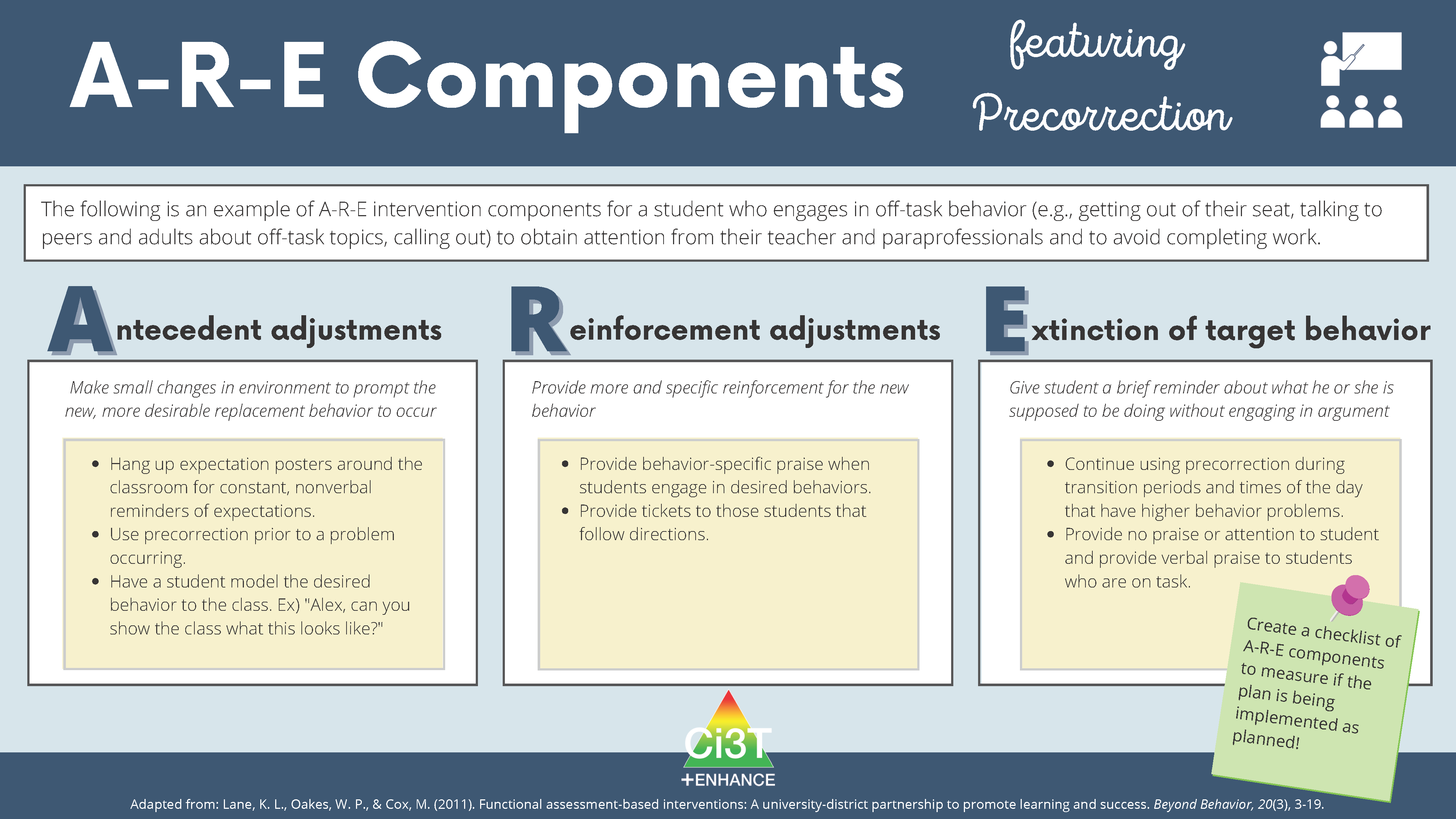
When designing an individualized intervention plan based on the reasons why challenging behaviors occur (a functional assessment-based intervention; FABI), a team collaborates to build an intervention made of up three A-R-E components:
- Antecedents to set the stage for desired behavior to occur
- Shifts in Reinforcements to make sure the desired behavior is working better to meet student’s needs than the undesirable behavior.
- Extinction of the behavior you would like to see less of in the future (target behavior)