Step 1: Identify contexts and anticipated behaviors
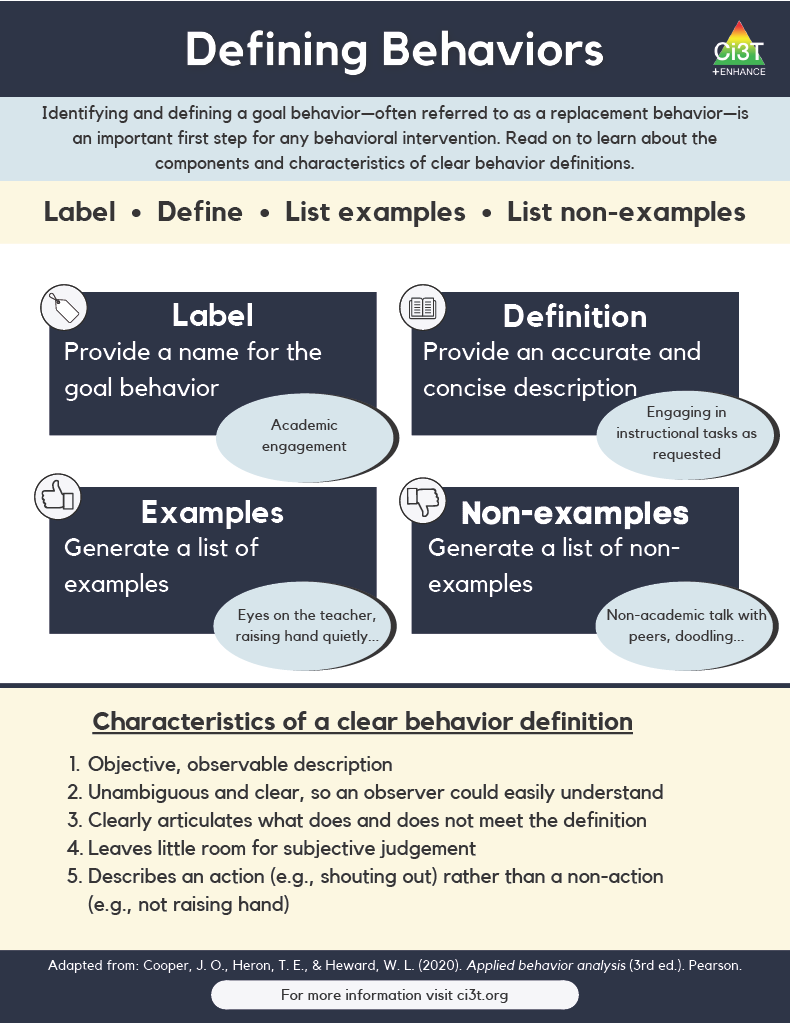
The first step is to identify (a) what challenging behaviors you are looking to reduce and (b) in which contexts those challenging behaviors are most likely to occur. It is helpful to operationally define the target behaviors so that everyone has a shared understanding of what the challenging behavior looks like. As discussed in the Module Understanding the Hows and Whys of Behavior to Support Change: Principles of Behavior Science, operationally defining a target behavior means describing the behavior in observable and measurable terms. When considering contexts in which challenging behaviors are most likely to occur, you may think about such factors as time of day (e.g., Are students more likely to call out in the morning? Later in the day?), type of activity (e.g., Are students more likely to engage in off-task behavior during small-group activities than during large-group instruction?), and location (e.g., Are students more likely to engage in aggressive behavior on the playground in elementary schools or during lunchtime in secondary schools? In the hallway?).