16 Student Outcomes: Testing the Strategy
When a teacher decides to use precorrection as a classwide support as part of Tier 1 practices, it is also possible to use this opportunity to “test” this as an intervention for students with moderate levels of risk. For example, it is possible to use precorrection for all students in a class but use it more intentionally to support a few specific students. In doing so, you might collect information on student performance, treatment integrity, and social validity to see how the intervention is working. You might take this approach for students who:
- score in the moderate risk range for externalizing and/or internalizing behaviors;
- receive a rating of targeted for growth in successful learning behaviors on report cards;
- struggle with beginning assignments during independent work; or
- exhibit consistent, predictable patterns of academic errors noted on progress and report cards
These are some of the entry criteria that might be built into your Secondary (Tier 2) Intervention Grids (see sample grids below).
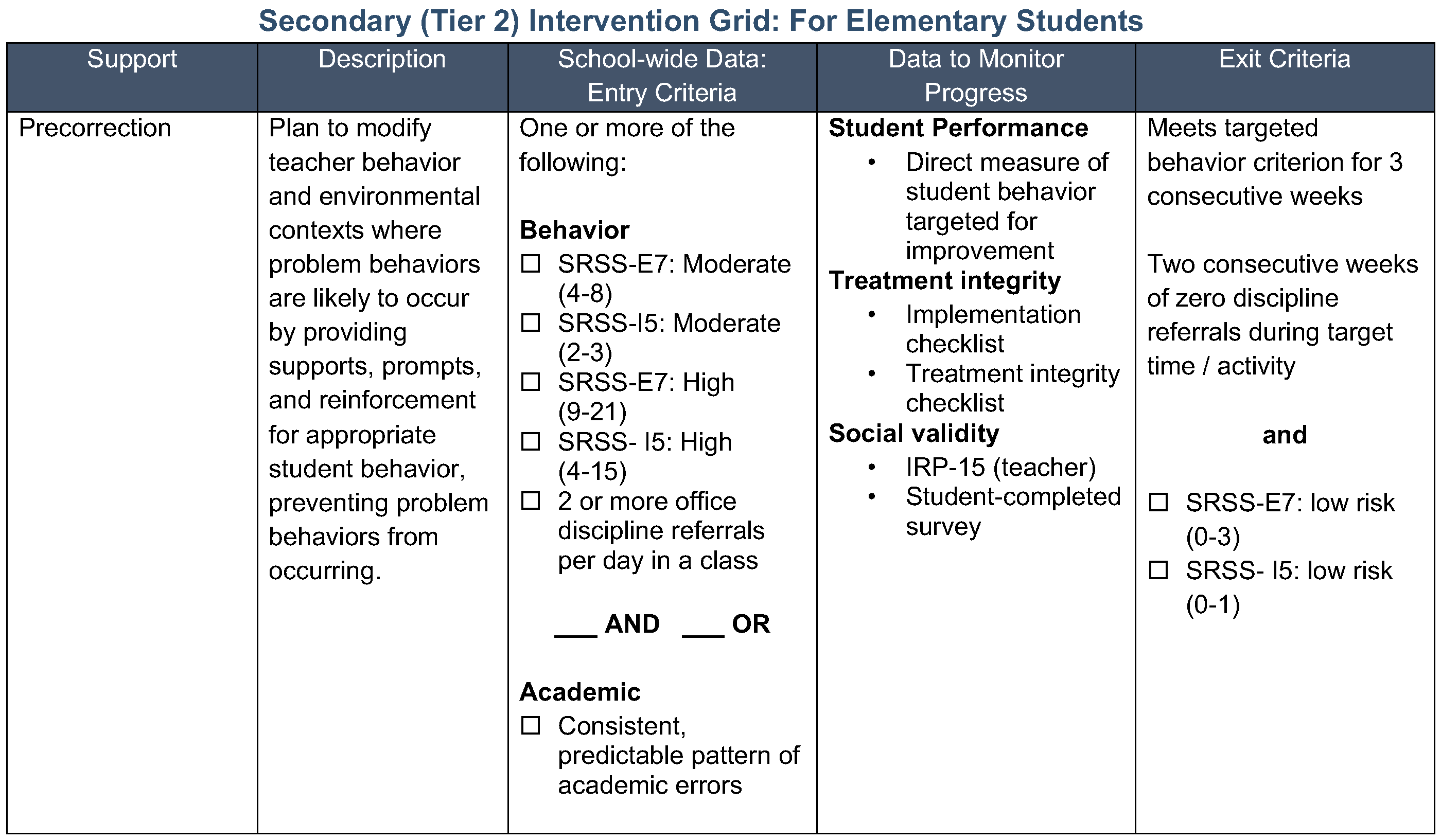
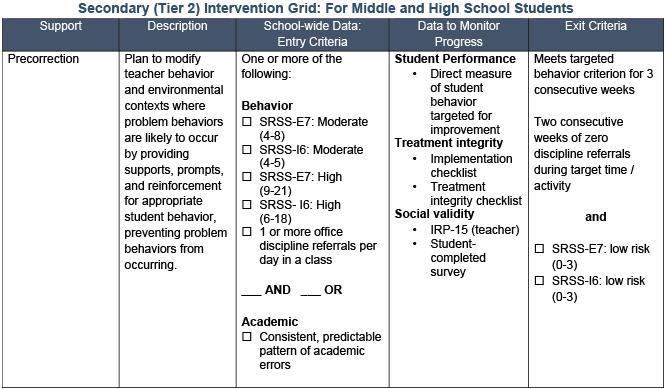
If there were 1-3 students in a class meeting these entry criteria, a teacher could “test” how well precorrection is working for those students.
One practical, flexible, and rigorous way to determine how well precorrection is working is to use single case methodology to “test” how well precorrection is affecting these 1-3 students’ performance in behaviors such as academic engaged time or percentage of work completed. For example, a classroom teacher could use an experimental design such as an A-B-A-B withdrawal design in which they first collected baseline data (phase A1, which we know is confusing since the A and not the B represents baseline!) for 3-5 days on these students’ levels of engagement (or work completion) before using precorrection with the whole class. Then, once data patterns are stable, the teacher can use precorrection (phase B1) with the whole class for at least 5 and up to 10 days and continue to collect data on just those 1-3 students’ levels of engagement (or work completion) to see if engagement increases and remains higher than baseline levels. Once it is clear engagement has improved, the teacher can stop using precorrection with the class for 3-5 days (return to baseline, A2) to see if the desired behavior (e.g., engagement) again decreases similarly to the first baseline phase (A1). After engagement has decreased and remained low, then the teacher re-introduces precorrection classwide and continues to collect data for another 5-7 days or so on just those 1-3 students to see if engagement (or work completion) again increases.
Full screen version of the above examining the effects of precorrection
You may wonder: “Why would I want to remove the intervention (stop using precorrection) if the students are finally engaged?” The brief withdrawal and re-introduction of the intervention is needed to know that it is precorrection and not some other thing happening in the classroom (e.g., dimming the lights, higher rates of praise) that is responsible for the change in student engagement. In behavioral terms, an experimental design such as an A-B-A-B design allows teachers to determine if there is a functional relationship between the introduction of the intervention and changes in student performance. More simply, the design allows us to confidently determine if the intervention “worked.”
To help you collect and graph data, such as those pictured above, we offer several data tracking tools that will help you assess student performance. You could also use a flexible data collection tool like Direct Behavior Rating (DBR) to assess student progress (learn more in the module Direct Behavior Rating to Support Classroom Behavior and Engagement). The linked data collection tools below provide you with a means of storing and graphing these data as part of ongoing efforts.
You can download the tiered intervention data manager as a MS-Excel file or copy the Google Sheets version to your Google Drive.
| Microsoft Excel | Google Sheets |
|---|---|
| Tiered Intervention Data Manager .xlsx | Tiered Intervention Data Manager Google |
This information can be used by the teacher to examine the effectiveness of this low-intensity strategy so that you can make practical adjustments to assist your students in accessing instruction and enjoying school. In addition, Ci3T Leadership Team members and professional learning community (PLC) members can also use these data to see how precorrection (as well as other strategies) works for a range of other students with moderate risk before moving on to other validated Tier 2 (e.g., Check-In/Check-out, self-monitoring) or Tier 3 supports (e.g., functional assessment-based interventions). Although these other Tier 2 and Tier 3 interventions are indeed effective, it is often helpful to first test out these small adjustments in teacher behaviors (using precorrection before challenging behaviors arise) before moving to other supports that may be more labor intensive.