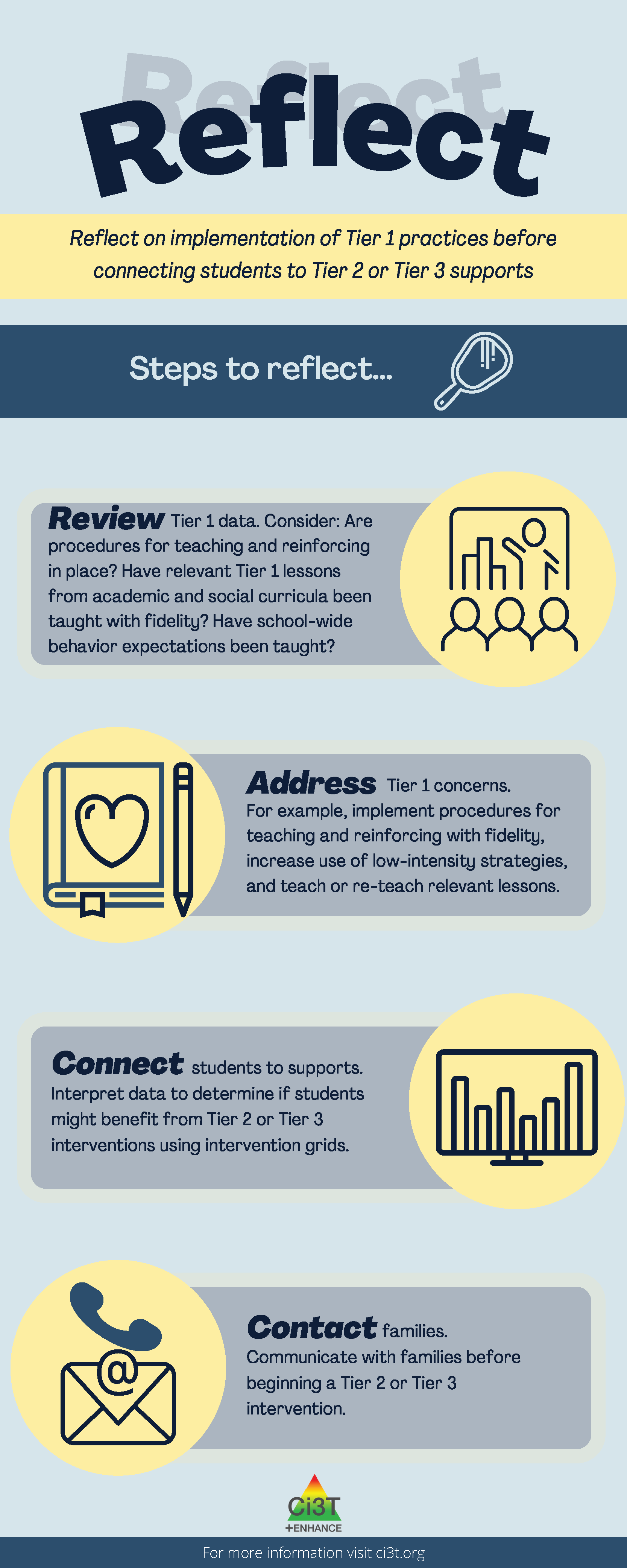
12 Reflect on Tier 1 Before Connecting Students to Tier 2
Before responding with any Tier 2 intervention – including precorrection – we encourage teachers to reflect on Tier 1 practices to determine what elements are in place as planned. As part of the reflection process, teachers should review Tier 1 data to ensure specific procedures for teaching and reinforcing are in place. For example, teachers and other staff (e.g., paraprofessionals, intervention specialists) might review their treatment integrity and social validity data to determine how academic instruction is taking place and how low-intensity strategies are being used to increase engagement (see the module Staying on Track: Using Data to Set Goals and Monitor Implementation Efforts for more information).
Treatment integrity data help teachers determine if students have access to essential Tier 1 practices such as having school-wide expectations that are taught, practiced, and reinforced using the school-wide acknowledgements (e.g., tickets). In addition, it is important to make certain the validated social and emotional well-being curriculum is being taught schoolwide as planned. For example, are social skills lessons (e.g., Second Step; Committee for Children, 2011) being taught schoolwide and revisited during academic instruction? Teachers can examine what lessons have been taught schoolwide, and if schoolwide data suggest there are lessons that could be helpful (e.g., decision-making, self-regulation, goal-setting, empathy), these additional lessons might be added to the schoolwide instructional schedule. Furthermore, teachers can reflect on the extent to which they are intentionally incorporating low intensity supports – including precorrection featured in this module – at Tier 1 to increase engagement, limit disruptions, and create enjoyable learning environments. Teachers can also use precorrection to remind students of well-timed opportunities for using (or practicing!) these new skills during instruction or social interactions throughout the day (e.g., when you are reading this next chapter, think about which characters did a good job of showing empathy to others and which characters could use more practice).
Before exploring more formal Tier 2 supports such as behavioral contracts and direct behavior ratings, we encourage teachers and other educators to first set goals (see the module Staying on Track: Using Data to Set Goals and Monitor Implementation Efforts, which includes SMART goal planning activities) for more intentional use of low-intensity strategies such as precorrection as part of Tier 1 practices and perhaps as an initial Tier 2 support to determine impact for students with moderate risk for internalizing and/or externalizing behaviors. Oftentimes, these adjustments during instruction will be effective for increasing desired behaviors (e.g., academic engagement or social interactions) and decreasing undesired behaviors (e.g., taking too long to start task; off-task, noncompliant, and disruptive).