1 Introduction
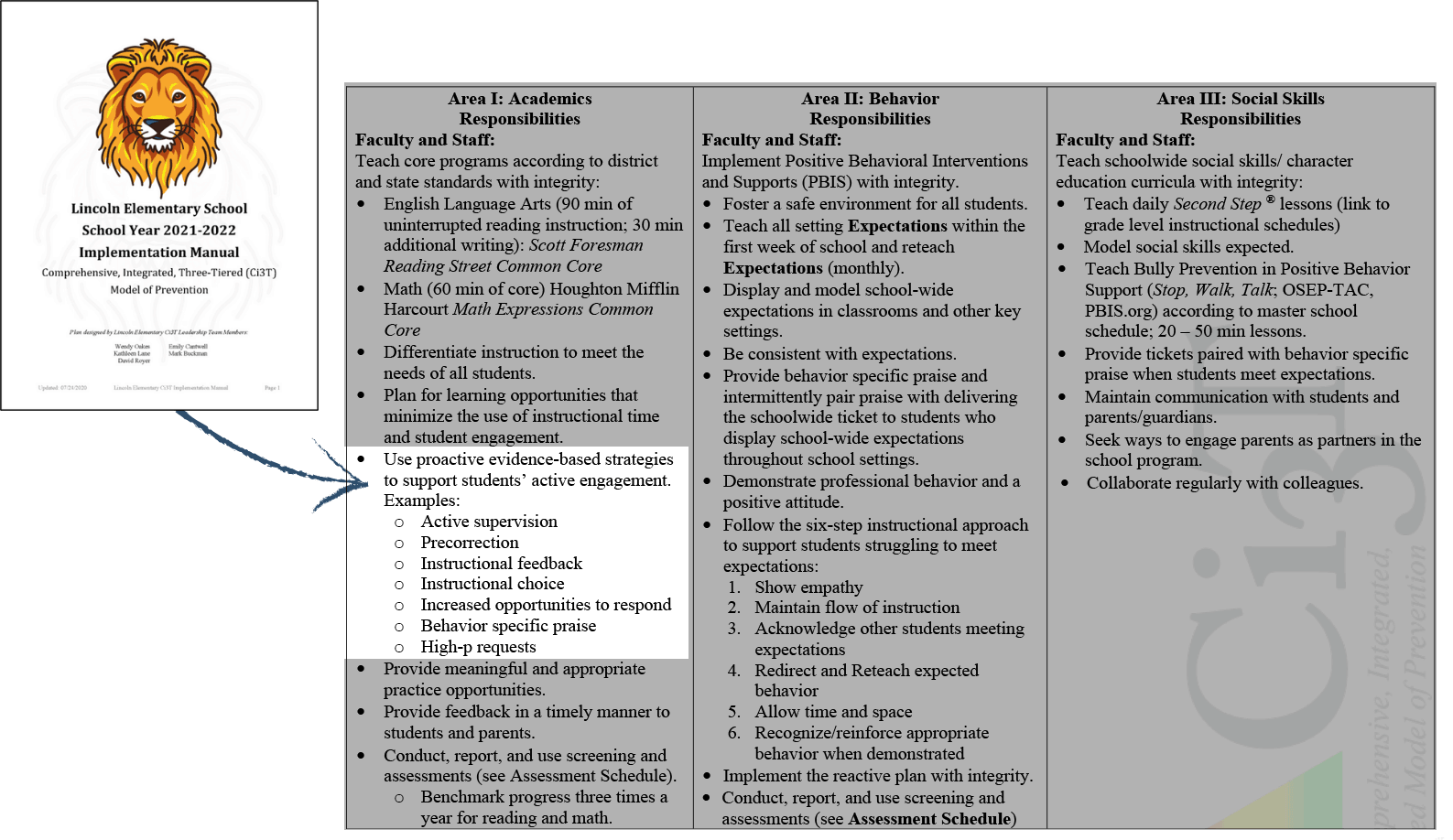
As we have shared in other modules, Ci3T models of prevention prioritize an integrated approach to instruction. When you look over the roles and responsibilities for faculty and staff in the academic domain, you will likely see strategies such as:
- Behavior-specific praise
- Precorrection
- Active supervision
- Increased opportunities to respond
- Instructional feedback
- Instructional choice
- High-probability requests
Faculty and staff use these low-intensity teacher-delivered strategies as part of Tier 1 instruction with all students to increase engagement, minimize disruption, and create positive, productive, inclusive learning environments (De Pry & Sugai, 2002; Ennis, Lane, Menzies et al., 2018; Ennis, Royer et al., 2018).
Ideally, these strategies are taught widely, empowering all adults with efficient, effective strategies that can be woven into daily instructional activities and used in non-instructional settings (e.g., hallways, cafeteria, arrival, dismissal) as well. In addition, these strategies can also be used more intentionally as a Tier 2 intervention for students with moderate levels of risk (e.g., Stormont et al., 2007).
 Precorrection is one such strategy that involves proactively changing aspects of the environment to promote student engagement and reduce the likelihood of challenging behavior. In this module, adapted from Lane, Menzies, Ennis, and Oakes (2015), we will first introduce precorrection for general use at Tier 1 by answering the following questions:
- What is precorrection?
- Why is precorrection effective?
- Where is precorrection situated in a Ci3T model?
- What does the supporting research say about precorrection?
- What are the benefits and challenges of precorrection?
- How do I implement precorrection in my classroom?
In the answer to the final question, we provide step-by-step guidance for using precorrection in your classroom. Then, we discuss how it can be used as a stand-alone Tier 2 support, integrated as a component into other Tier 2 supports (e.g., precorrection integrated into small group social skills or reading instruction), or incorporated as one component of a Tier 3 support (e.g., an antecedent-based intervention component of a functional assessment-based intervention, FABI; Umbreit et al., 2007). We close by outlining how you can monitor use of precorrection, including how to assess student outcomes (are my students making progress?), treatment integrity (is it being implemented as planned?), and social validity (how do stakeholders feel about the goals, procedures, and outcomes of precorrection?).