


Articles and Special Issues
Journal Special Issues
Using Low-Intensity Strategies to Support Engagement: Practical Applications in Remote Learning Environments for Teachers and Families
This special issue is all about low-intensity strategies for teachers and families in remote settings.
Low-intensity Strategies
Volume 27, Issue 3, published December 2018 in Beyond Behavior: A Journal Exploring Behaviors of Children and Youth
The Volume 27, Issue 3, 2018 special series on low-intensity strategies in Beyond Behavior, Effective Low-Intensity Strategies to Enhance School Success: What Every Educator Needs to Know, provides easy-to-use resources to learn about and implement effective, efficient, low-intensity strategies that support academic engagement and prevent or reduce challenging behavior. The issue may be purchased through the link above, or check with your affiliated university library to see if they have a subscription to Beyond Behavior.
Ci3T Step-by-Step Guide
Volume 58, Issue 3, published May 12, 2014, in Preventing School Failure: Alternative Education for Children and Youth
The Volume 58, Issue 3, 2014 special issue of Preventing School Failure, Designing, Implementing, and Evaluating Comprehensive, Integrated, Three-Tiered Models of Prevention: A Step-by-Step Guide, walks the reader through Ci3T from start to finish. The issue may be purchased through the link above, or check with your affiliated university library to see if they have a subscription to Preventing School Failure.
You may also view and download companion PowerPoint presentations for each article below:
Companion Downloads
Abstract: Comprehensive, integrated, three-tiered models are context specific and developed by school-site teams according to the core values held by the school community. In this article, the authors provide a step-by-step, team-based process for designing comprehensive, integrated, three-tiered models of prevention that integrate academic, behavioral, and social domains. First, the authors discuss the importance of beginning with securing commitments and clarifying agreements. Second, they describe the core elements of a comprehensive, integrated, three-tiered plan. Then, they outline a 6-part, data-informed training series, emphasizing the importance of incorporating feedback from stakeholders to inform design through an iterative process.
- Read the article
Reference: Lane, K. L., Oakes, W. P., Jenkins, A., Menzies, H. M., & Kalberg, J. R. (2014). A team-based process for designing comprehensive, integrated, three-tiered (Ci3T) models of prevention: How does my school-site leadership team design a Ci3T model? Preventing School Failure: Alternative Education for Children and Youth, 58(3), 129-142. doi: 10.1080/1045988X.2014.893976
Abstract: Comprehensive, integrated, three-tiered models are context specific and developed by school-site teams according to the core values held by the school community. In this article, the authors provide a step-by-step, team-based process for designing comprehensive, integrated, three-tiered models of prevention that integrate academic, behavioral, and social domains. First, the authors discuss the importance of beginning with securing commitments and clarifying agreements. Second, they describe the core elements of a comprehensive, integrated, three-tiered plan. Then, they outline a 6-part, data-informed training series, emphasizing the importance of incorporating feedback from stakeholders to inform design through an iterative process
- Read the article
Reference: Lane, K. L., Oakes, W. P., Jenkins, A., Menzies, H. M., & Kalberg, J. R. (2014). A team-based process for designing comprehensive, integrated, three-tiered (Ci3T) models of prevention: How does my school-site leadership team design a Ci3T model? Preventing School Failure: Alternative Education for Children and Youth, 58(3), 129-142. doi: 10.1080/1045988X.2014.893976
Abstract: In this article, the authors clarify the role of the leadership team, providing a rationale for one integrated team to examine academic, social, and behavioral programming, with careful attention to including all key stakeholders. Next, the authors discuss the procedures for teaching all key stakeholders the comprehensive, integrated, three-tiered plan, followed by information on how to reinforce these groups for participation in the plan and meeting expectations. Then, the authors introduce core components needed to ensure accurate decision making with respect to primary prevention efforts: treatment integrity, social validity, accurate detection using systematic screening tools, and data-informed decisions. The authors conclude with a brief summary of how to implement and monitor Tier 1 efforts.
- Read the article
Reference: Lane, K. L., Oakes, W. P., & Magill, L. (2014). Primary prevention efforts: How do we implement and monitor the tier 1 component of our comprehensive, integrated, three-tiered (Ci3T) model? Preventing School Failure: Alternative Education for Children and Youth, 58(3), 143-158. doi: 10.1080/1045988X.2014.893978
Abstract: In this article, the authors clarify the role of the leadership team, providing a rationale for one integrated team to examine academic, social, and behavioral programming, with careful attention to including all key stakeholders. Next, the authors discuss the procedures for teaching all key stakeholders the comprehensive, integrated, three-tiered plan, followed by information on how to reinforce these groups for participation in the plan and meeting expectations. Then, the authors introduce core components needed to ensure accurate decision making with respect to primary prevention efforts: treatment integrity, social validity, accurate detection using systematic screening tools, and data-informed decisions. The authors conclude with a brief summary of how to implement and monitor Tier 1 efforts.
- Read the article
Reference: Lane, K. L., Oakes, W. P., & Magill, L. (2014). Primary prevention efforts: How do we implement and monitor the tier 1 component of our comprehensive, integrated, three-tiered (Ci3T) model? Preventing School Failure: Alternative Education for Children and Youth, 58(3), 143-158. doi: 10.1080/1045988X.2014.893978
Abstract: In comprehensive, integrated, three-tiered models, it is essential to have a systematic method for identifying students who need supports at Tier 2 or Tier 3. This article provides explicit information on how to use multiple sources of data to determine which students might benefit from these supports. First, the authors provide an overview of how to make an assessment schedule for all schoolwide data. Second, the authors outline how to create a blueprint for Tier 2 and Tier 3 supports in a given school, including a description of the strategy or practice; inclusionary criteria; data to monitor progress; and exit criteria. Last, the authors provide an overview of how to connect students to support and monitor their progress.
- Read the article
Reference: Lane, K. L., Oakes, W. P., Ennis, R. P., & Hirsch, S. E. (2014). Identifying students for secondary and tertiary prevention efforts: How do we determine which students have tier 2 and tier 3 needs? Preventing School Failure: Alternative Education for Children and Youth, 58(3), 171-182. doi: 10.1080/1045988X.2014.895573
Abstract: School-site and district-level leadership teams rely on the existing knowledge base to select, implement, and evaluate evidence-based practices meeting students’ multiple needs within the context of multitiered systems of support. The authors focus on the stages of implementation science as applied to Tier 2 and Tier 3 supports; the importance of school-site expertise to select, implement, and monitor the use of evidence-based Tier 2 and Tier 3 practices to address the academic, behavioral, and social needs of students; and evidence-based guidelines for professional development. Together these practices ensure school-site leadership teams focus available resources for addressing data-based needs and achieving desired student outcomes.
- Read the article
Reference: Oakes, W. P., Lane, K. L., & Germer, K. A. (2014). Developing the capacity to implement tier 2 and tier 3 supports: How do we support our faculty and staff in preparing for sustainability? Preventing School Failure: Alternative Education for Children and Youth, 58(3), 183-190. doi: 10.1080/1045988X.2014.895575
Books
Featured Books
Managing Challenging Behaviors in Schools: Research-Based Strategies that Work, Second Edition
Now in a fully revised second edition, this acclaimed, highly practical book reviews the breadth of proven strategies for preventing and responding to problem behavior in K-12 classrooms. Meeting the needs of real-world practitioners, the expert authors address all three tiers of intervention within a Comprehensive, Integrated, Three-Tiered (Ci3T) Model of Prevention. Educators are guided to implement effective instructional and classroom management practices to meet students’ learning, behavioral, and social and emotional well-being needs (Tier 1). Chapters also describe more intensive interventions for students who need more than Tier 1 efforts have to offer (Tiers 2 and 3 interventions). In a convenient large-size format, the volume includes more than a dozen reproducible and downloadable forms.
New to This Edition
Updated conceptual framework reflecting the ongoing development of the authors’ Ci3T Models of Prevention.
- Chapter on direct behavior ratings
- Chapter on building a professional learning plan
- Boxed “Reflections and Tips for Success” from practitioners in every chapter
(From: Guilford Press)
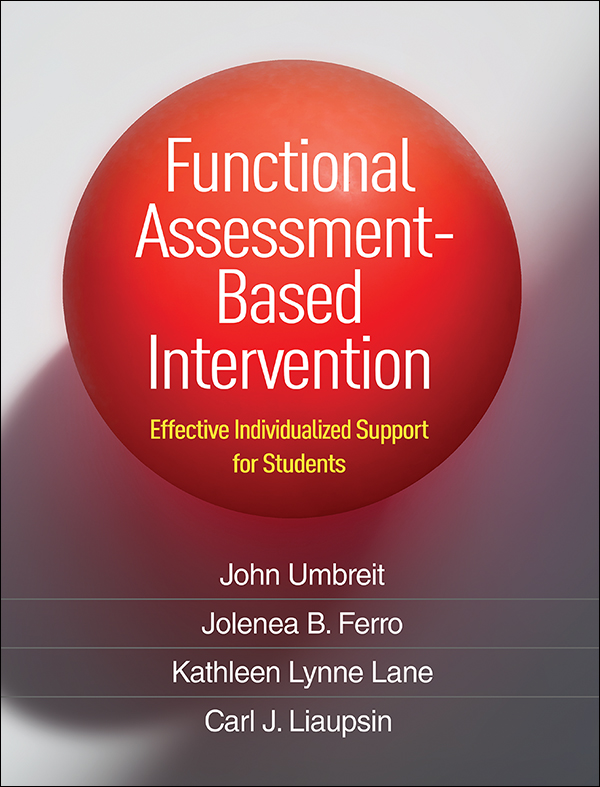
Functional Assessment-Based Intervention: Effective Individualized Support for Students
From noted authorities, this book presents a comprehensive approach to designing and implementing evidence-based Tier 3 behavior interventions for K-12 students. The authors’ functional assessment-based intervention (FABI) process has been supported by multiple peer-reviewed studies conducted in authentic educational environments. Step by step, chapters spell out proven methods to define target behaviors, determine the function of the undesirable behavior, identify appropriate replacement behaviors, and deliver and monitor intensive interventions. Illustrated with real-world case examples, the book shows how to embed FABI within a school’s integrated tiered system of supports.
Guidance for scaling FABI at the district and statewide levels is also provided. Ethical issues, professional standards, equity concerns, and cultural and linguistic considerations are addressed throughout. In a convenient large-size format, the book includes reproducible checklists and forms that can also be downloaded for ease of use. (From: Guilford Press)
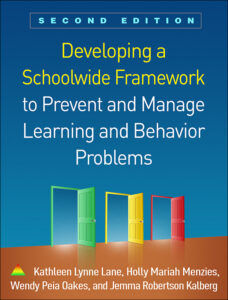
Developing a Schoolwide Framework to Prevent and Manage Learning and Behavior Problems
“Now revised and expanded, this volume explains how to design, implement, and evaluate a comprehensive, integrated, three-tiered (Ci3T) model of prevention. Rather than presenting a packaged program, the book provides resources and strategies for designing and tailoring Ci3T to the needs and priorities of a particular school or district community. Ci3T is unique in integrating behavioral, academic, and social-emotional components into a single research-based framework. User-friendly features include tools for collecting and using student and schoolwide data; guidance for selecting effective interventions at each tier; detailed case examples; and tips for enhancing collaboration between general and special educators, other school personnel, and parents. In a convenient large-size format, the volume includes several reproducible forms that can be downloaded and printed for repeated use.” (From: Guilford Press)
Building and Installing Comprehensive, Integrated, Three-Tiered (Ci3T) Models of Prevention: A Practical Guide to Supporting School Success (First Edition)
The focus of this practical guide is to support the design, implementation, and evaluation of Comprehensive, Integrated, Three-Tiered (Ci3T) Models of Prevention to promote student success academically, behaviorally, and socially. Ci3T models of prevention are a data-informed, graduated system of prevention designed to meet students’ academic, behavioral, and social needs in an efficient, practical, and collaborative structure. In essence, Ci3T models represent a broad framework for not only meeting students’ academic and behavioral needs as in Multi-Tier System of Supports models, but also their social and emotional needs using tiered logic.
This interactive eBook provides a step-by-step guide through the Ci3T six-day professional learning series that takes place over one academic school year. It is designed for Ci3T Leadership Team members who attend a Ci3T professional learning series to provide additional information to frame each session, including the documents, videos, and resources needed to build a Ci3T Blueprint. Each chapter also includes Tips for Ci3T Trainers who provide the professional learning series, a Coach’s Corner for Ci3T Coaches who support school teams at each session, and a section for District Decision-Makers as they begin the system’s change process.
This edition includes 500 pages of rich content, including over 140 interactive galleries, documents, and videos. (From: Fishbowl Publishing; Apple Books)

Supporting Behavior for School Success: A Step-by-Step Guide to Key Strategies
“Designed for busy teachers and other school-based professionals, this book presents step-by-step guidelines for implementing seven highly effective strategies to improve classroom management and instructional delivery. These key low-intensity strategies are grounded in the principles of positive behavior intervention and support (PBIS), and are easy to integrate into routine teaching practice. Chapters discuss exactly how to use each strategy to decrease disruptive behavior and enhance student engagement and achievement. Checklists for success are provided, together with concise reviews of the evidence base and ways to measure outcomes. Illustrative case examples span the full K-12 grade range. Reproducible intervention tools can be downloaded and printed in a convenient 8½” x 11″ size.” (From: Guilford Press)

All Books